
… when imagination becomes reality.

The process of simplifying
The challenge
Expanding virtual possibilities bring us amazing virtual experiences and detailed image accuracy and with them comes an array of technical solutions, where the amount of options makes it hard to anticipate the ideal balance between available technical and visual possibilities and current as well as future user needs. As a VR-installation can be quite an investment, it is more likely to act broad and include than to think small and exclude during decision-making. As time flies and VR-solutions are integrated in the workflow, it becomes more obvious which options have become essential or redundant. The same applies to user interaction, which is unavoidably symbiotically linked to the complexity in the technical aspects behind the scene of virtual reality.
In 2011-2012 NANCO installed a combined cave and powerwall in one room including a double 5.5m * 2.9m powerwall. By 2019 Volvo Cars decided to simplify both the custom-made and highly performing double powerwall system and the user’s interaction with the powerwall’s complex functionality as it thus far had required a skilled operator.
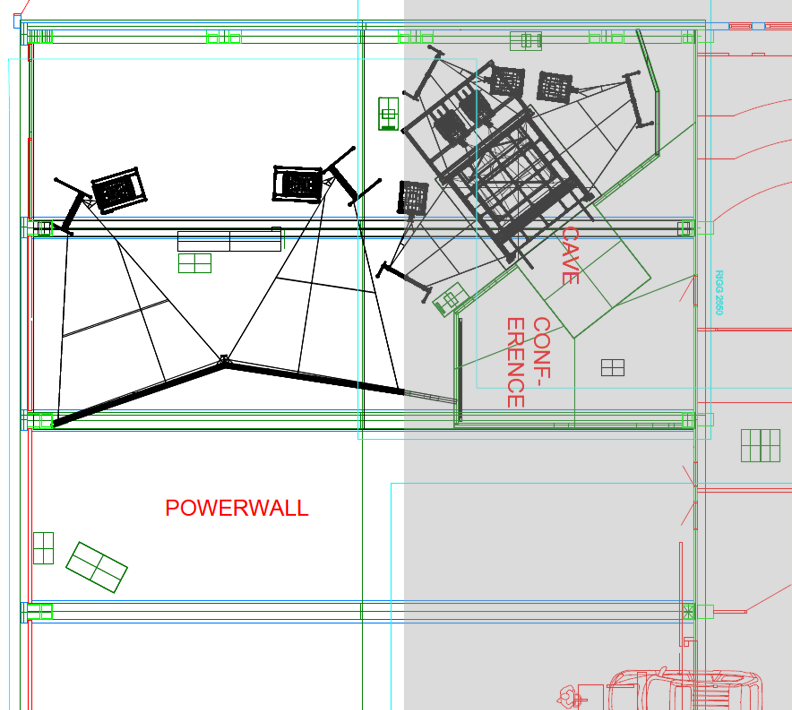
Revisiting Volvo Cars’ double powerwall in VR-studio © NANCO
Even Volvo Cars’ smaller VR-theatre, formerly upgraded in 2016, needed some revisiting and simplifying. Read more about the previous update in the theatre “Further upgrade to expand the virtual possibilities even more”.

Revisiting Volvo Cars’ VR-theatre © NANCO
The solution
Together with Volvo Cars NANCO redesigned the current system and reduced some of its functionality, partly based on changes in the rendering workflow at Volvo Cars. This streamlining process required in-depth knowledge of the underlying technology and available solutions.
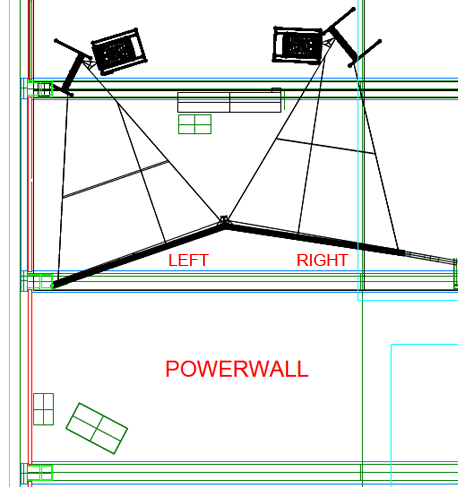
A complex amount of image sources was reduced to one image processor handling 3 standard Volvo Cars computers integrated into Volvo’s network and an additional Bring-your-own-device laptop (BYOD): two of the computers and the BYOD displaying either on the left or on the right powerwall, while the third computer only displays in wide format using both as one powerwall.
© NANCO
On the user side of the technology, each computer is now represented by its own set of keyboard and mouse, thereby eliminating extra fuss with (re)plugging computers, and by two monitors mirroring the current display on the double powerwall. Furthermore, as the control system used for managing the double powerwall needed to reflect the trimmed functionality, the system was totally renewed and simplified making the entire powerwall accessible to all Volvo approved users.
This simplified back and front-end set-up enables the user to fully prepare the presentation on the monitors, rather than on the fully powered-up powerwall as in the past, before finally turning on the projectors shortly before the presentation.
Some trimming had to be done in the VR-theatre as well, reducing it to one image source: either using one super computer with maximized performance or one BYOD-laptop. Parallelly the control system was renewed and simplified as well.
The outcome
A more technically and user efficient back and front-end.